Pixlosopher · generative

EIDOS

Ninety-nine beings in a cave.

There are ninety-nine faces in this collection and not one of them has been rendered. Every being mints as a shadow on the wall. What it becomes — whether it ever turns around, what it does once it can see — is not up to me.

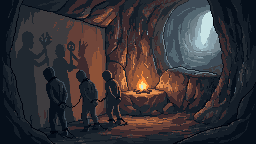
A cave interior in pixel art: three chained figures face a rock wall on the left,
              their shadows thrown across it larger than they are. A fire burns on a low platform
              behind them, and at the right the cave opens onto cold daylight.
Behind them, a fire. Above the fire, a road; and a low wall built along the road. Republic 514b
514a · the wall

This is the entire collection.

Ninety-nine silhouettes. Hover one to see it breathe; choose one to walk it out. 44 × 44 px · one seed each
515c–516a · the ascent

Walk one out of the cave.

Nothing here is a picture of a picture. The engine is running in this tab, and every frame below is being computed from a single seed as you read.

01

animating

517c–520a · the three destinies

Then it has to decide what it is for.

Plato does not end at the sun. The one who gets out has to work out what seeing obliges him to do — and the collection makes that a choice its holder takes once, in public, forever.

the mechanism

You do not unlock a face. You burn a veil.

Every ascent destroys something, permanently, on chain. What is destroyed is not the person — it is the image you had of them. The spell for it already existed: An Quas, to dispel illusion.

The being is never burnt

One token, one lineage, kept for life. What burns is the veil over it — a real burn, to the zero address, one way.

Seven days dazzled

After each ascent its eyes have to adjust before it can climb again. Written into the allegory, and fatal to anyone in a hurry.

Doing nothing is a strategy

Every ascent burns a shadow out of existence. If eighty of the ninety-nine climb, the nineteen that stayed become the rarest state in the collection — by never turning around.

Ninety-nine, and no more

Nothing in the system mints a hundredth. Not the manipulator, not the liberator, not me.

the long version

For whoever looks it up.

Where the pictures come from

Four things are braided here. Ultima Online gives the format — the bust portrait, the one-pixel ink outline, three tones of shading — and the names: every being carries a Word of Power, Kal Vas Flam, Quas Ylem, In Lor. Ultima's magic is a grammar, so a modifier in front of a phrase is a valid new phrase, and that is how ninety-nine of them stay distinct.

Dungeons & Dragons gives the eight schools of magic, and each one leaves a different mark: Evocation throws sparks, Illusion casts a chromatic double, Necromancy wears its own skull, Divination opens a third eye, Abjuration seals the corners of the frame.

Surrealism gives the Enigma — Magritte's apple and bowler, a lit doorway in the chest, a cage for a torso, one enormous eye, a head that is weather, a head that is night, a head that is fire. They are not costumes. They are what a person looks like when they have only ever known themselves as a shadow.

Platonism gives everything else: the fire, the chains, the wall, and the Eidos — a perfect Form, circle or triangle or square, always the cleanest thing in the frame, the only object in the picture that is not of this cave. A few beings carry the Divided Line itself, drawn in its own proportion, two to four to four to eight.
Why a being is the same person at every stage

A being is an identity, not a picture. School, tone, view, headwear, robe, enigma, Form, atmosphere and framing are drawn once and never depend on where it stands on the path. Only light, shadow, fire, gaze and chains change as it climbs.

That sounds obvious and it is the hardest constraint in the engine. Each path trait consumes exactly one random draw in every phase, so moving a being along the path can never shift the die underneath it. Add one draw that only some phases make and all ninety-nine become other people.

What the flicker is for

Every piece is animated, and the amount it moves is the distance to the truth. Firelight shudders. Daylight drifts. At the fourth stage the amplitude reaches zero and the image stops — not slowed, stopped. Nothing moves: not the light, not the air.

The stillness is not a style. It is the argument.

How much of this is a model

None of it. No image was ever sampled and there is no diffusion anywhere in the pipeline. Ninety-nine seeds go into a hand-written engine of about sixty kilobytes; the same seed returns the same pixels on any machine, forever, and the repository fails its own test if a single one of them moves. That test covers every being in every state — eight hundred and ninety-one images, each pinned by hash.

The engine you are looking at is that engine. It is not a copy of it, and it is not a folder of exports. Your browser is running the artwork.

the cave

Take a shadow.

You are not signing up for a list. You are walking in and sitting down with the others, facing the wall, with no idea yet what you look like.

Not open yet. The chain this runs on is still being chosen, and I would rather hold nothing of yours until it is. Follow @pixlosopher — the cave opens there first.